

How Much Weight Can You Lose on Phentermine?
The average monthly weight loss on phentermine is not a precise figure because weight loss varies significantly from person to person. Some patients lose weight relatively quickly, while others experience more gradual changes. Starting weight, pre-existing medical conditions, genetics, diet, physical activity, and other factors all affect individual phentermine weight loss results.
Clinical trials show that phentermine can help people lose more weight on average than placebo when combined with lifestyle changes. This is confirmed by the phentermine results we see from our community.
However, there is no single monthly weight-loss average that accurately predicts everyone’s results.
How Phentermine Helps With Weight Loss

Phentermine is a prescription appetite suppressant that acts on the central nervous system. It primarily works by increasing the activity of certain neurotransmitters involved in appetite regulation, helping reduce hunger and making it easier to eat fewer calories (
Phentermine is not a miracle pill. The medicine is intended to be used alongside a reduced-calorie diet, physical activity, and behavioral changes. Although some people experience stimulant effects, appetite suppression is its main role in weight management.
How Much Weight Can I Expect to Lose on Phentermine?
Losing 5% of your starting body weight is a commonly used benchmark for assessing response to weight-loss medication after approximately three months (
For example, a 5% reduction would mean losing 10 pounds from a starting weight of 200 pounds or 12.5 pounds from 250 pounds.
Your prescribing clinician can help determine an appropriate treatment goal and assess whether phentermine is effective and safe for you. Because phentermine alone is FDA-approved only for short-term use, treatment decisions also depend on its prescribing information and your individual circumstances.
The following table illustrates what a 5% reduction in starting body weight looks like at different weights.
| Starting weight | Weight after 5% loss | Pounds lost |
|---|---|---|
| 140lb | 133lb | 7lb |
| 160lb | 152lb | 8lb |
| 180lb | 171lb | 9lb |
| 200lb | 190lb | 10lb |
| 220lb | 209lb | 11lb |
| 240lb | 228lb | 12lb |
| 260lb | 247lb | 13lb |
| 280lb | 266lb | 14lb |
| 300lb | 285lb | 15lb |
These are mathematical examples of a 5% reduction in body weight, not predictions or guaranteed results from taking phentermine.
While these modest weight loss goals may seem disappointing to some more ambitious dieters, it is healthier (and more sustainable) to lose weight slowly and steadily. Rapid, dramatic weight loss may be rewarding in the short term, but it is much harder to maintain and increases your risk of lean muscle loss and nutritional deficiencies.
Unfortunately, the short-term nature of this medication makes many patients feel like they need to lose as much weight as possible, as quickly as possible.
Phentermine is FDA-approved for short-term weight management, described in its prescribing information as treatment lasting a few weeks (
Some healthcare providers prescribe phentermine for longer periods off-label. However, longer-term treatment requires individualized medical assessment, including monitoring of treatment effectiveness, potential side effects, blood pressure, and heart rate. Patients should discuss the benefits and risks of continued treatment with their prescribing clinician.
Average Weight Loss With Phentermine
How much weight can you lose on phentermine in a month? There is no single average that accurately predicts everyone’s results. Weight loss varies depending on starting weight, individual response to the medication, eating habits, physical activity, and other health factors.
Clinical studies can provide useful estimates, but their results should not be interpreted as guaranteed outcomes.
What Do Clinical Studies Show?
Research on phentermine alone has reported different average weight-loss results depending on the study population, treatment duration, and lifestyle interventions.
| Study | Study duration | Average weight loss |
|---|---|---|
| Kim et al. (2013, | 12 weeks | 8.4 pounds (3.8 kg) |
| Kim et al. (2006, | 14 weeks | 14.8 pounds (6.7 kg) |
The 2013 study followed 711 patients included in its efficacy analysis. The 2006 randomized trial included 68 participants and compared phentermine with placebo alongside behavioral therapy.
A 2013 randomized controlled trial evaluated the effects of phentermine alone, topiramate alone, their combination, and placebo over 28 weeks (
These results show that phentermine can support meaningful weight loss, but individual outcomes vary. The study’s 28-week treatment period also exceeds the FDA-approved short-term indication for phentermine alone and should not be interpreted as an approved treatment duration.
How Much Weight Can You Lose in the First Month?
Some people notice weight changes within the first few weeks of taking phentermine, while others lose weight more gradually. Although weight loss may be faster during the first month for some patients, published research does not establish a reliable average for this period.
Two factors may contribute to faster initial weight loss:
- Appetite suppression. Phentermine helps reduce appetite, which may make it easier to consume fewer calories. However, the strength and duration of this effect vary between individuals.
- Loss of water weight. Early weight loss can partly reflect changes in body water. When the body uses stored glycogen for energy, it also releases associated water, which can lead to a quicker drop on the scale (
7 ).
As a result, weight loss during the first few weeks may not reflect fat loss alone, and the rate of weight loss may slow over time. A slower start does not necessarily mean phentermine is ineffective.
What About Three Months?
Research provides more useful information about weight loss over approximately three months.
For example, the studies above reported mean reductions of approximately 8.4 and 14.8 pounds over their respective 12- and 14-week observation periods (
These figures are study averages, not a predicted range for individual patients. Some participants lost more, others lost less, and not everyone achieved a clinically meaningful response.
Losing at least 5% of starting body weight is a commonly used benchmark for evaluating the effectiveness of weight-loss medication after approximately three months. It is not a minimum amount that everyone taking phentermine is expected to lose.
What About Six Months or One Year?
Phentermine alone is FDA-approved for short-term weight management. Some clinicians prescribe it for longer periods off-label, but evidence about longer-term outcomes is more limited.
Observational research suggests that longer-term phentermine use may be associated with greater weight loss than shorter-term use.
In a 1968 randomized trial, patients receiving continuous phentermine treatment alongside dietary advice lost an average of 27 pounds over 36 weeks, compared with 10.5 pounds in the placebo group (
A 2019 observational study involving 13,972 adults examined weight-loss outcomes among patients taking phentermine for different lengths of time. Researchers found that patients who used phentermine continuously for more than 12 months had lost 7.4 percentage points more of their starting body weight after two years than patients who used it for three months or less (
Although these findings suggest that longer-term use may be associated with greater weight loss, the study was observational and cannot establish that longer treatment caused the difference. Phentermine alone remains FDA-approved for short-term use.
How Do Patient Success Stories Compare?
Some people report substantial weight loss while taking phentermine.
For example, Sarah lost more than 20 pounds a month on phentermine, focusing on healthy eating, proper hydration, and regular activity during her phentermine journey.
These personal experiences can be informative and encouraging, but they should not be treated as evidence of typical results.
Published clinical research is a more appropriate source for understanding average outcomes, while patient stories illustrate how much individual experiences can vary.
Qsymia: Average Weight Loss
Qsymia, a brand name combination of phentermine HCL and topiramate-ER, is an FDA-approved medication containing phentermine and extended-release topiramate. Unlike phentermine alone, Qsymia is approved for long-term weight management (
A 2012 study found that patients who took the highest dose of phentermine-topiramate (15 mg phentermine HCL + 92 mg topiramate-ER daily) lost significantly more weight than those who took a lower dose of phentermine-topiramate or a placebo (
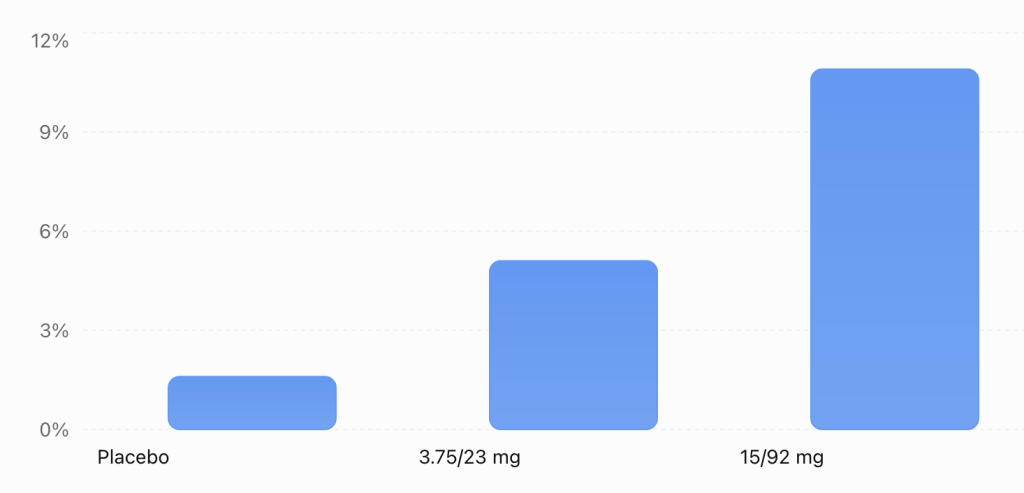
Given that the starting weight in this group was an average of 253 pounds, that translates to an almost 28-pound weight loss in just one year.
A 2016 systematic review and network meta-analysis estimated that 75% of participants receiving phentermine/topiramate achieved at least 5% weight loss at approximately one year, compared with a median 23% of placebo recipients (
Back to Phentermine Reviews and Results
- National Center for Biotechnology Information. PubChem Compound Database: CID=4771 (Phentermine).
- Apovian, C. M., Aronne, L. J., Bessesen, D. H., McDonnell, M. E., Murad, M. H., Pagotto, U., Ryan, D. H., & Still, C. D. (2015). Pharmacological Management of Obesity: An Endocrine Society Clinical Practice Guideline.The Journal of Clinical Endocrinology & Metabolism,100(2), 342-362. doi:10.1210/jc.2015-1782
- Division of Nutrition, Physical Activity, and Obesity, National Center for Chronic Disease Prevention and Health Promotion. (2018, February 13). Losing Weight | Healthy Weight | CDC.
- Buchwald, H., Cowan, G. S., & Pories, W. J. (2007). Surgical management of obesity. Philadelphia, PA: Elsevier.
- U.S. Food and Drug Administration. (2012). Adipex-P (phentermine hydrochloride) capsules label [Brochure].
- Phentermine User Reviews for Weight Loss at Drugs.com. (2019, April 18).
- Mayo Clinic Staff. (2018, February 06). Weight loss stalled? Move past the plateau.
- Kim, K. K., Cho, H., Kang, H., Youn, B., & Lee, K. (2006). Effects on Weight Reduction and Safety of Short-Term Phentermine Administration in Korean Obese People.Yonsei Medical Journal, 47(5), 614. doi:10.3349/ymj.2006.47.5.614
- Kim, H. O., Lee, J. A., Suh, H. W., Kim, Y. S., Kim, B. S., Ahn, E. S., Park, Y. G. (2013). Postmarketing Surveillance Study of the Efficacy and Safety of Phentermine in Patients with Obesity. Korean Journal of Family Medicine, 34(5), 298. doi:10.4082/kjfm.2013.34.5.298
- Various users. (2018, August 23). Phentermine Success Stories at Phentermine.com.
- Munro, J. F., Maccuish, A. C., Wilson, E. M., & Duncan, L. J. (1968). Comparison of continuous and intermittent anorectic therapy in obesity. British Medical Journal, 1(5588), 352-354. doi:10.1136/bmj.1.5588.352
- Khera, R., Murad, M. H., Chandar, A. K., Dulai, P. S., Wang, Z., Prokop, L. J., Singh, S. (2016). Association of Pharmacological Treatments for Obesity With Weight Loss and Adverse Events.JAMA, 315(22), 2424. doi:10.1001/jama.2016.7602
- Allison, D. B., Gadde, K. M., Garvey, W. T., Peterson, C. A., Schwiers, M. L., Najarian, T., Day, W. W. (2011). Controlled-Release Phentermine/Topiramate in Severely Obese Adults: A Randomized Controlled Trial (EQUIP).Obesity, 20(2), 330-342. doi:10.1038/oby.2011.330
- Lewis KH, et al. (2019). Safety and Effectiveness of Longer-Term Phentermine Use: Clinical Outcomes from an Electronic Health Record Cohort. Obesity, 27(4), 591–602. pubmed.ncbi.nlm.nih.gov/30900410/
- Aronne LJ, Wadden TA, Peterson C, Winslow D, Odeh S, Gadde KM. (2013). Evaluation of phentermine and topiramate versus phentermine/topiramate extended-release in obese adults. Obesity, 21(11), 2163–2171. https://doi.org/10.1002/oby.20584
